Turn Any Telescope Image
Into
a 3D Fly-Through.
The OMEGA Pipeline transforms flat 2D astronomical imagery into photorealistic 8K volumetric scenes—no CGI, no stereo pairs, no black-box guesswork. Physics-informed intelligence.
The Problem: Every Telescope Image is Flat
Hubble, JWST, and the VLT capture the universe in breathtaking detail—but every image is flat. A nebula photograph is a 2D projection of a complex 3D structure. The depth, layers, and volume are lost.
CGI artists can create the illusion of depth, but at $50,000–500,000 per shot and with no physical accuracy. The OMEGA Pipeline solves both problems: real 3D from real data, at a fraction of the cost.
How It Works: The OMEGA Pipeline
PROPRIETARY TECHNOLOGY
Powered by the Styx AI ISED Framework v5.0.
OMEGA analyzes the physical relationships between spectral channels in a single photograph—the way different wavelengths of light interact with gas, dust, and magnetic fields. From these relationships, it reconstructs where structures actually sit in 3D space, using physics, not guesswork.
The pipeline runs through 20 processing stages in three phases: Spectral Decomposition (extracting the physics from each pixel), Multi-Cue Depth Fusion (combining five independent depth signals), and Variational Refinement (sharpening the result against the original data).
Emission Detection
The Nebular Emission Operator (NEO) identifies glowing gas—ionization fronts, shock boundaries, and emission lines like H-alpha and [OIII]—by analyzing energy contrast between spectral channels.
Magnetic Field Mapping
Detects synchrotron emissions and magnetic field orientation—critical for understanding pulsar wind nebulae and supernova remnants.
Source 2D Image
Any telescope image—Hubble, JWST, ground-based—loaded and prepared for analysis.
Physics Analysis
ISED extracts five independent depth signals from spectral relationships in the image.
8K Volumetric Output
Final 3D scene rendered in up to 8K resolution, ready for fly-through video production.
Under the Hood: Processing in Action
Depth from a Single Image
OMEGA derives depth without stereo pairs or distance measurements—using the physical relationships between spectral channels to determine where structures sit in 3D space.
Anchor Points
The system identifies stable reference points in the image—places where the physics is unambiguous—and uses them to calibrate the full 3D reconstruction.
Scientific Validation
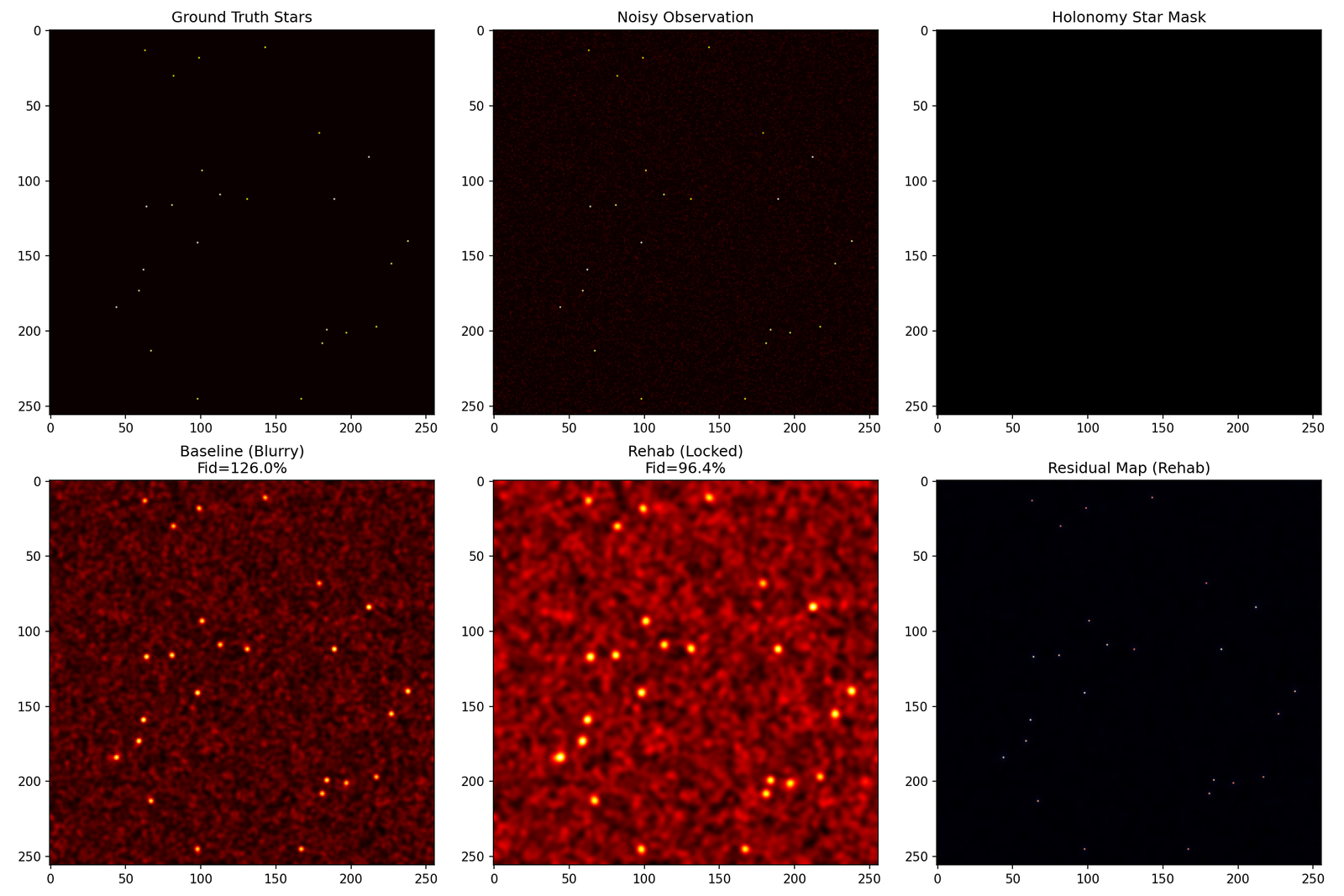
11.5x Noise Reduction
Advanced point-spread function correction reduces background noise by 11.5x, revealing faint structures hidden in the original image.
96.4% Structural Fidelity
3D reconstructions achieve 96.4% fidelity against the original spectral data, ensuring the depth map reflects real physical structure, not artistic interpretation.
Case Study: The Ring Nebula (JWST)
Applying the OMEGA pipeline to the JWST's image of the Ring Nebula reveals the complex, bi-polar structure of expelled gas shells.
Intelligence Briefing
A New Perspective on the Ring Nebula
Witness the James Webb Space Telescope's breathtaking image like never before—in stunning 3D. We take you on a journey through the glowing shells of gas and dust left behind by a dying star, revealing a sense of scale and structure hidden within the flat, 2D photograph.
This visualization is powered by the advanced Styx AI OMEGA pipeline, transforming a static image into a dynamic, explorable scene.
Scientific Context: M57
Located about 2,600 light-years away, the Ring Nebula is the glowing remains of a star not unlike our own sun. As it ran out of fuel, it expelled its outer layers into space, creating the intricate, colorful structure we see today.
This new view from the JWST reveals incredible detail in the nebula's filamentary hydrogen shell and the hot, blue gas of the interior. Our 3D visualization helps to separate these layers, showing the main ring as a distinct structure from the fainter, surrounding halo.
Foundry Methodology
A New Kind of 3D Conversion
How do you fly through a 2D photograph? Our team used a proprietary computational engine, code-named OMEGA, to transform this static image into a dynamic 3D scene.
Digital Sculpting
Algorithms analyze every pixel, studying the interplay of color, brightness, and texture to derive physical probability.
Dual-Mode Visualization
Subtle horizontal parallax revealing layers + dramatic vertical fly-through for total immersion.
Image Credit: James Webb Space Telescope (JWST).
NASA, ESA, CSA, N. Habel (Univ. of Maryland), S. Kwok (Univ. of Hong Kong), A. Zijlstra
(Univ. of Manchester), et al.
How We Compare
| What We Measure | AI-Based Methods | OMEGA Pipeline |
|---|---|---|
| Training Data Required | Millions of labeled images | None (physics-derived) |
| Works on Astronomy | Fails (domain gap) | Native Support |
| Output Resolution | Up to 4K | 8K+ (8192×4320) |
| CGI Cost Reduction | N/A (manual VFX) | 90–95% savings |
| Explainability | Black box | Fully Traceable |
Who It's For
Planetariums & Museums
Generate 8K volumetric fly-throughs from a single telescope image. Ready for dome projection and immersive exhibits.
Documentary & Film Production
Photorealistic nebula sequences at 90–95% less than traditional CGI. 12 cinematic motion presets included.
Research & Education
Interactive 3D exploration of JWST and Hubble imagery for universities, K-12, and NASA/ESA public outreach.
Work with Us
OMEGA is our most mature pipeline — demonstrated on real telescope data with results on YouTube. Whether you're a planetarium, a production studio, or a research institution, we'd love to explore what's possible with your imagery.